
Lady Mary Wortley Montagu (née Pierrepont; 15 May 1689 – 21 August 1762) was an English poet, writer and aristocrat. Known as a voracious reader from a young age, her father left her education up to her governess, as was the standard at the time. Subsequently, her days were filled with stolen hours in the library of her home, reading all manner of books.
She managed to teach herself Latin, a language considered only useful to men during the period, and would go on to learn French, Italian and Turkish. She married an English diplomat and travelled throughout Europe and Turkey.
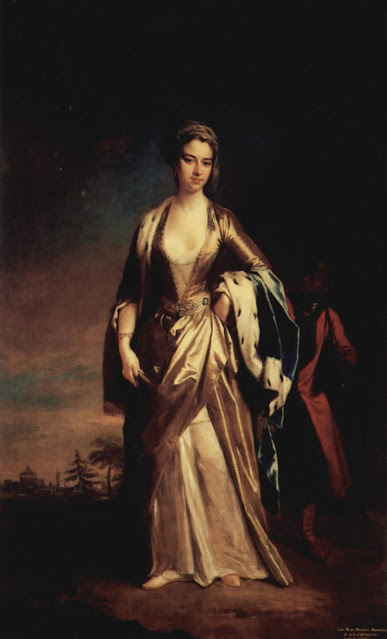
Portrait of Lady Mary Wortley Montagu by Jonathan Richardson
It is her private letters, The Turkish Embassy Letters, published many years later, that she would be most known for. These letters, with their lively and detailed descriptions, particularly of the lives of Turkish women, would inspire generations of female travellers.
She had contracted smallpox in England which left her with some disfiguration. Because of this, she was interested in the methods of inoculation she witnessed in Turkey. She is credited with introducing this medical practice to Europe.
Often frustrated by the limitations put upon her sex, she endeavoured to defy conventions. When her father refused to approve of her choice of husband, she chose to elope. She worked hard to ensure her education was as thorough as any man’s, and was a popular figure at court, often debating academics and corresponding with literary figures of the day.
In 1736 she is said to have met and began an affair with the younger Venetian academic, Francesco Algarotti. In 1739, she left England without her husband, declaring that she intended to winter in the south of France.
In reality, she had left to live with Algarotti in Venice and would never see her husband again. This relationship, which proved to be short-lived, is thought to have inspired the poem, ‘Hymn to the Moon,’ as it makes reference to young Endymion.
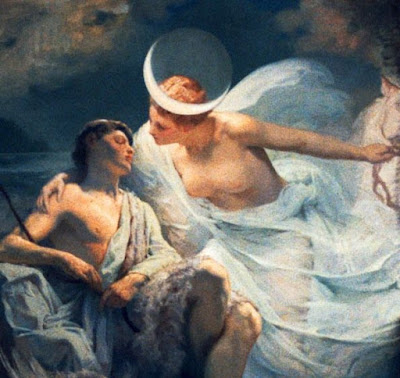
Ceiling at Ny Carlsberg Glyptotek, Copenhagen
Endymion is a figure of Greek mythology that Selene, the Titan moon goddess, falls in love with (this myth is later attributed to the Roman lunar goddess, Diana). In order to preserve him so that he will live forever, she places him into a deep sleep and visits him every night.

Selene and Endymion by Ubaldo Gandolfi circa 1770
In this sense, his myth is attributed to an older woman falling for an unattainable younger man. In Hymn to the Moon, Lady Montagu confides in the moon goddess of her hopeless love of Algarotti, knowing that Selene will understand how she feels.
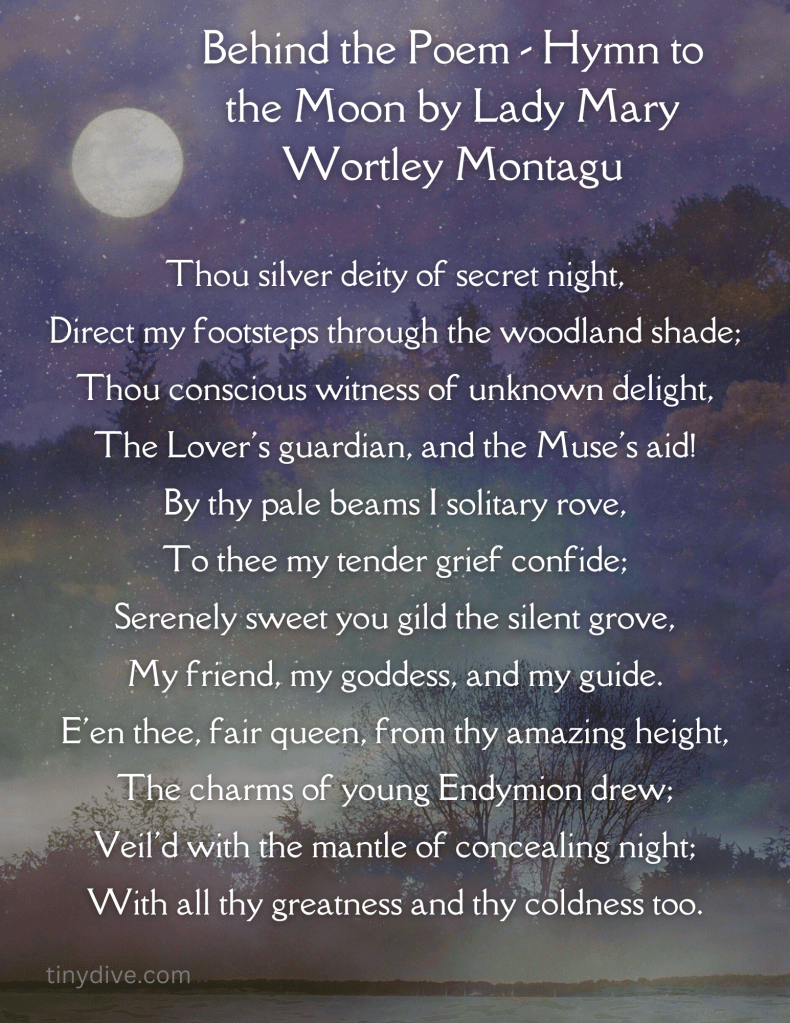
Thou silver deity of secret night,
Direct my footsteps through the woodland shade;
Thou conscious witness of unknown delight,
The Lover’s guardian, and the Muse’s aid!
By thy pale beams I solitary rove,
To thee my tender grief confide;
Serenely sweet you gild the silent grove,
My friend, my goddess, and my guide.
E’en thee, fair queen, from thy amazing height,
The charms of young Endymion drew;
Veil’d with the mantle of concealing night;
With all thy greatness and thy coldness too.
 Tiny Dive
