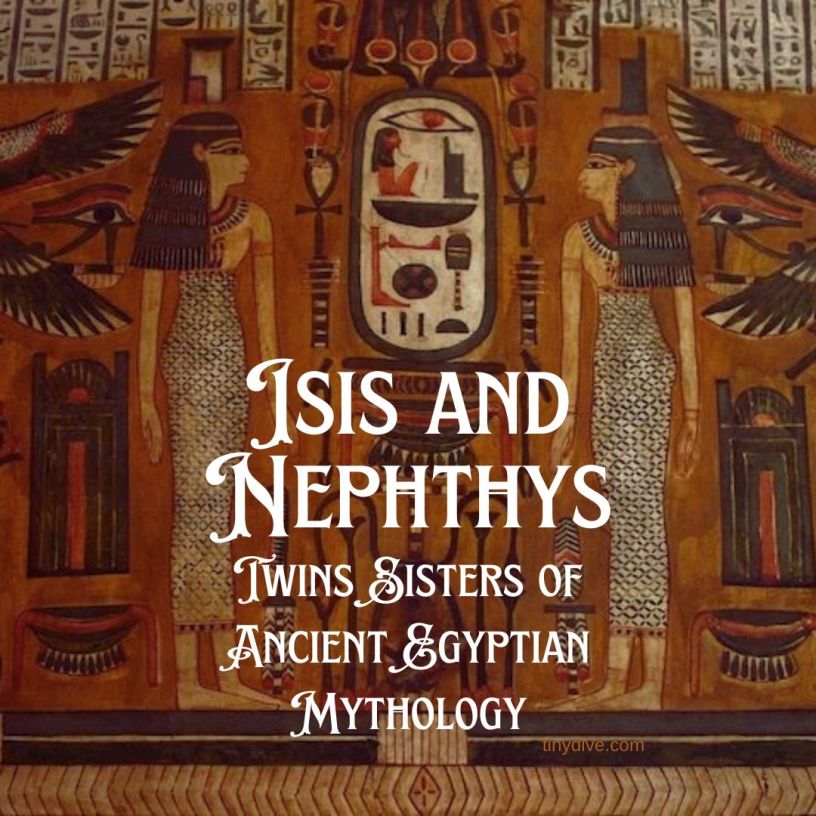
In Ancient Egyptian mythology, Isis and Nephthys are among the most significant deities, revered for their roles in the cosmic and mythological stories that shaped the beliefs of ancient Egyptians. Though often described as twin sisters, their roles and personalities are complementary rather than identical. As goddesses, they are deeply intertwined with themes of life, death, protection, and the afterlife. Their mythological narratives reveal much about the values and worldview of Ancient Egypt, emphasizing loyalty, the power of the family, and the eternal struggle between life and death.
The Origins and Attributes of Isis and Nephthys
Isis and Nephthys were born from the sky goddess Nut and the earth god Geb. They were part of the divine family that also included their brothers Osiris and Set. Isis, the elder sister, was married to Osiris, while Nephthys was married to Set. Despite their familial connection, the sisters had distinct roles in the Egyptian pantheon. Isis was revered as a powerful goddess of magic, motherhood, and fertility. She was known for her wisdom and was often depicted as a loving mother figure, particularly to her son Horus, whom she protected and nurtured.
Nephthys, on the other hand, was associated with the aspects of death, mourning, and the afterlife. Although she was often considered more passive than her sister, she played a crucial role in funerary rituals, offering comfort to the deceased. She was known for her compassion and ability to guide souls through the challenges of the afterlife. Nephthys’ role as a protective deity was especially important in funerary contexts, where she helped to guard and assist the dead on their journey.
The Myth of Osiris: A Story of Loyalty and Betrayal
One of the most well-known myths in which Isis and Nephthys play a central role is the story of Osiris, their brother, and husband to Isis. This myth explores the themes of betrayal, resurrection, and the cyclical nature of life and death. According to the myth, Osiris ruled as a just and beloved king of Egypt. However, his jealous brother Set, driven by a desire for power, conspired against him. Set trapped Osiris in a coffin and cast it into the Nile, later dismembering his body and scattering the pieces throughout Egypt.
Isis and Nephthys, united by their devotion to Osiris, set out to recover the pieces of his body. This act of loyalty demonstrated their sisterly bond and their commitment to restoring order from chaos. Isis, known for her magical prowess, used her abilities to reassemble Osiris’s body and temporarily resurrect him, enabling them to conceive their son, Horus. Nephthys assisted in the rituals and mourning, offering her own powers to help complete the process of resurrection. This narrative illustrates the cooperative nature of the sisters, as well as the balance between life and death that they embodied.
Isis and Nephthys in Funerary Practices
The roles of Isis and Nephthys extended beyond mythological stories; they were deeply integrated into the religious and cultural practices of Ancient Egypt, particularly in the realm of funerary rituals. As goddesses of protection, they were often invoked to guard the deceased and to guide souls through the afterlife. They were depicted on tomb walls, sarcophagi, and coffins, standing beside the mummy of the deceased to offer their protection.
Isis was often depicted with outstretched wings, symbolizing her protective nature, while Nephthys was shown alongside her, emphasizing their joint role in guarding the soul. In funerary texts such as the Book of the Dead, they were invoked as part of the rituals that ensured the deceased’s safe passage to the afterlife. Their presence in these texts reflects their importance in maintaining the cosmic balance between life and death, and their role in the Egyptian belief in the afterlife as a continuation of existence rather than a final end.
The Symbolic Relationship Between Isis and Nephthys
The relationship between Isis and Nephthys symbolizes the duality inherent in many aspects of Ancient Egyptian religion. Isis represents life, birth, and the nurturing aspects of nature, while Nephthys represents the shadows, death, and the mysteries of the afterlife. This duality is not one of opposition, but of balance, where both sisters are necessary to the proper functioning of the cosmos.
In their complementary roles, they embody the Egyptian concept of ma’at, the principle of harmony and balance that governed both the universe and human society. By working together to restore Osiris, they upheld the balance between life and death, demonstrating that death was not an end but a part of a continuous cycle. Their intertwined nature reflects the belief that life and death are inextricably linked, with each goddess playing a role in guiding the soul through these transitions.
The Enduring Legacy of Isis and Nephthys
The influence of Isis and Nephthys extended far beyond the borders of Ancient Egypt, as their mythologies and attributes were adopted and adapted by other cultures. Isis, in particular, became a prominent figure in the Greco-Roman world, where she was worshiped as a goddess of magic, healing, and the protector of sailors. Temples dedicated to Isis were built throughout the Mediterranean, and her cult spread across the Roman Empire, making her one of the most enduring figures in ancient religion.
Nephthys, though less prominent in later cultural adaptations, remained a key figure in Egyptian funerary art and literature, symbolizing the protective aspects of the afterlife. Together, the sisters left a lasting imprint on Egyptian mythology and religion, embodying the cultural values of loyalty, family, and the eternal cycle of life and death.
Conclusion
Isis and Nephthys, as twin sisters in Ancient Egyptian mythology, represent the complex interplay between life and death, creation and destruction, and order and chaos. Through their roles in the myth of Osiris, they demonstrate the power of loyalty and familial bonds, while their presence in funerary practices underscores their importance in guiding souls through the mysteries of the afterlife. As deities, they are not merely figures of myth, but symbols of the enduring values and beliefs of Ancient Egypt, which sought to understand the nature of existence and the mysteries of the cosmos. The stories of Isis and Nephthys remind us of the richness of the ancient world’s spiritual landscape, where even death was seen as part of a greater cosmic harmony.
 Tiny Dive