
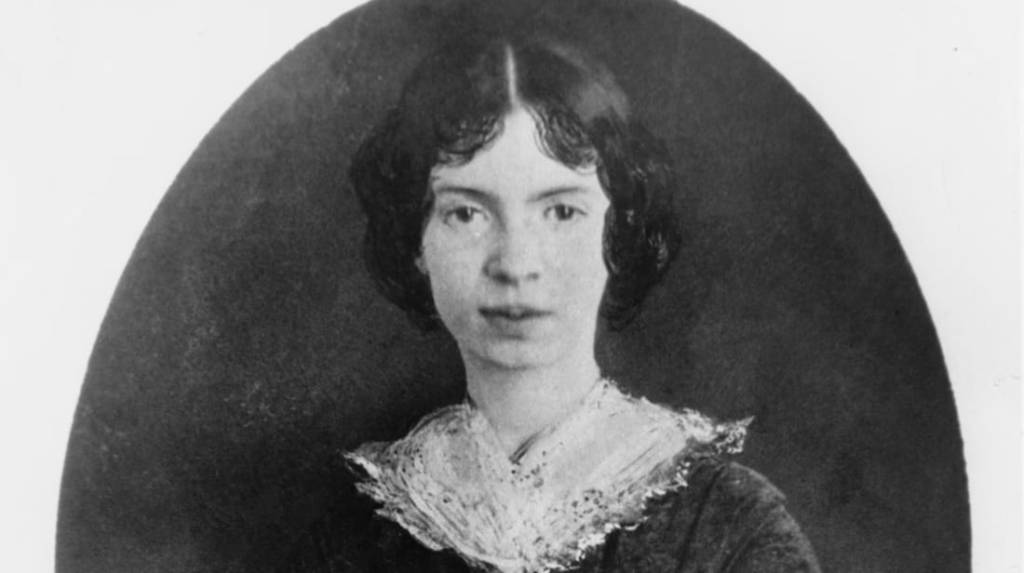
Emily Dickinson‘s poem “Because I Could not Stop for Death” is one of her most celebrated works, exploring themes of mortality, the passage of time, and the afterlife. Through personification, vivid imagery, and a calm, contemplative tone, Dickinson presents death not as something to be feared but as an inevitable, natural part of life.
Structure and Form
The poem consists of six quatrains with an ABCB rhyme scheme, which provides a rhythmic and steady pace, mirroring the unhurried journey described in the poem. This regular structure contrasts with the profound and often unsettling subject matter, creating a sense of calm and inevitability.
Personification of Death
From the outset, Dickinson personifies Death as a kind and civil gentleman who stops for the speaker. This characterization is a departure from the traditional depiction of Death as a grim and fearsome figure. By portraying Death as a courteous suitor, Dickinson softens the concept and makes it more approachable. The idea that Death “kindly stopped” for the speaker suggests a mutual understanding and acceptance.
The Journey and Passage of Time
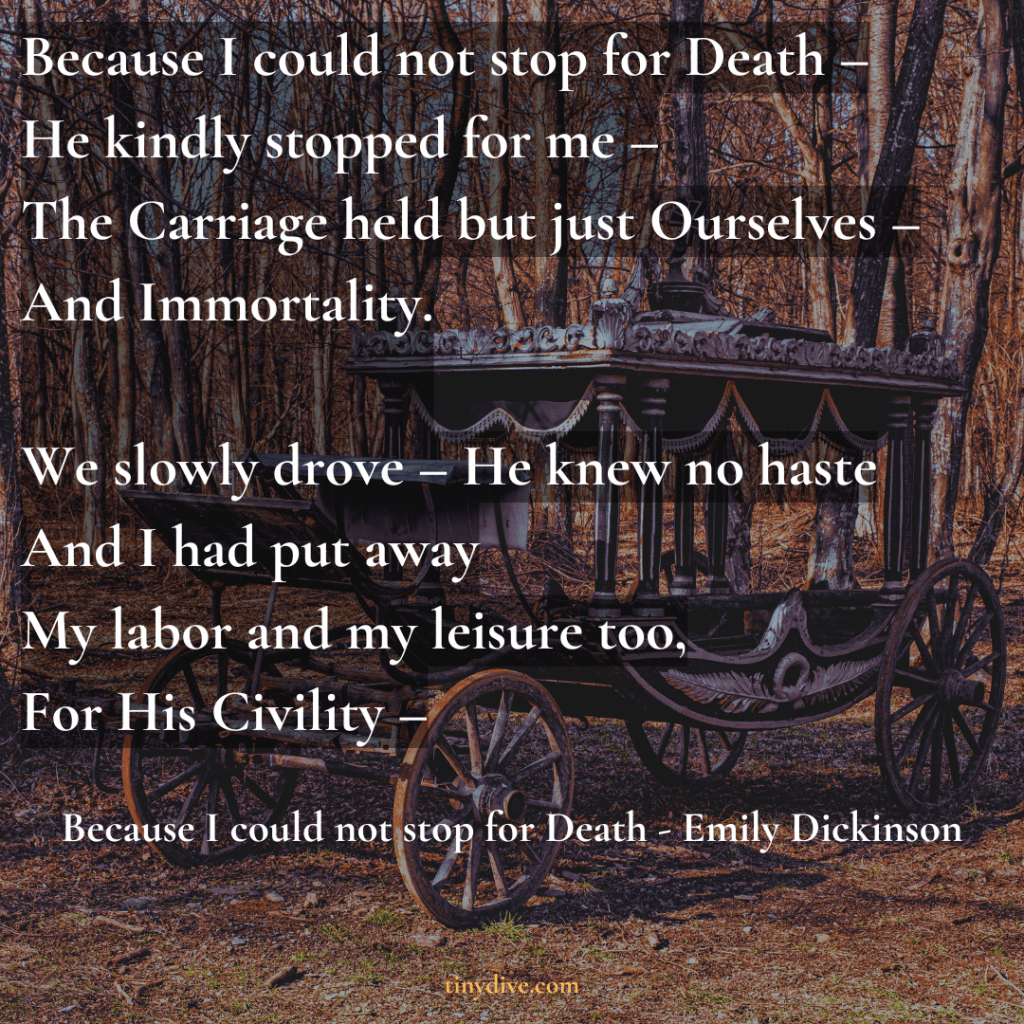
The journey that the speaker takes with Death and Immortality is a central metaphor in the poem. As they travel in the carriage, they pass through various scenes that symbolize different stages of life. The “School, where Children strove / At Recess—in the Ring” represents childhood and the innocence of youth. The “Gazing Grain” symbolizes maturity and the productivity of adulthood. Finally, the “Setting Sun” signifies old age and the end of life. This progression underscores the natural cycle of life and the inevitability of death.
Imagery and Symbolism
Dickinson employs rich imagery to convey the poem’s themes. The carriage ride itself is a metaphor for the transition from life to death. The “Gossamer” gown and “Tippet—only Tulle” worn by the speaker suggest the ethereal and insubstantial nature of the afterlife. The description of the house that “seemed / A Swelling of the Ground” is a metaphor for a grave, indicating the final resting place.
The depiction of the house also introduces a shift in the poem’s tone. The imagery of a “Swelling of the Ground” evokes a sense of burial and the physical reality of death. However, the poem concludes with the speaker’s realization that the journey is eternal: “Since then—’tis Centuries—and yet / Feels shorter than the Day / I first surmised the Horses’ Heads / Were toward Eternity.” This final stanza suggests that time loses its meaning in the face of eternity, and the speaker’s journey with Death is unending.
Themes of Mortality and Immortality
“Because I Could not Stop for Death” delves deeply into the themes of mortality and immortality. The poem presents death as a natural and necessary transition rather than a final end. By riding with Immortality, the speaker acknowledges the continuation of existence beyond physical death. The calm and measured tone of the poem reflects an acceptance of death as part of life’s cycle.
Dickinson’s contemplation of eternity offers a nuanced perspective on the afterlife. The notion that centuries can feel “shorter than the Day” speaks to the timeless nature of existence beyond death. This idea is both comforting and profound, suggesting that the fear of death can be mitigated by the understanding that life, in some form, continues indefinitely.
Conclusion
Emily Dickinson’s “Because I Could not Stop for Death” is a masterful exploration of death and the afterlife. Through personification, vivid imagery, and contemplative tone, Dickinson transforms death from a source of fear into a peaceful and inevitable transition. The poem encourages readers to reflect on their own mortality and the nature of existence beyond death. By presenting death as a gentle and courteous guide, Dickinson offers a perspective that is both comforting and thought-provoking, underscoring the natural cycle of life and the promise of immortality.
Because I could not stop for Death –
He kindly stopped for me –
The Carriage held but just Ourselves –
And Immortality.
We slowly drove – He knew no haste
And I had put away
My labor and my leisure too,
For His Civility –
We passed the School, where Children strove
At Recess – in the Ring –
We passed the Fields of Gazing Grain –
We passed the Setting Sun –
Or rather – He passed Us –
The Dews drew quivering and Chill –
For only Gossamer, my Gown –
My Tippet – only Tulle –
We paused before a House that seemed
A Swelling of the Ground –
The Roof was scarcely visible –
The Cornice – in the Ground –
Since then – ’tis Centuries – and yet
Feels shorter than the Day
I first surmised the Horses’ Heads
Were toward Eternity –
 Tiny Dive