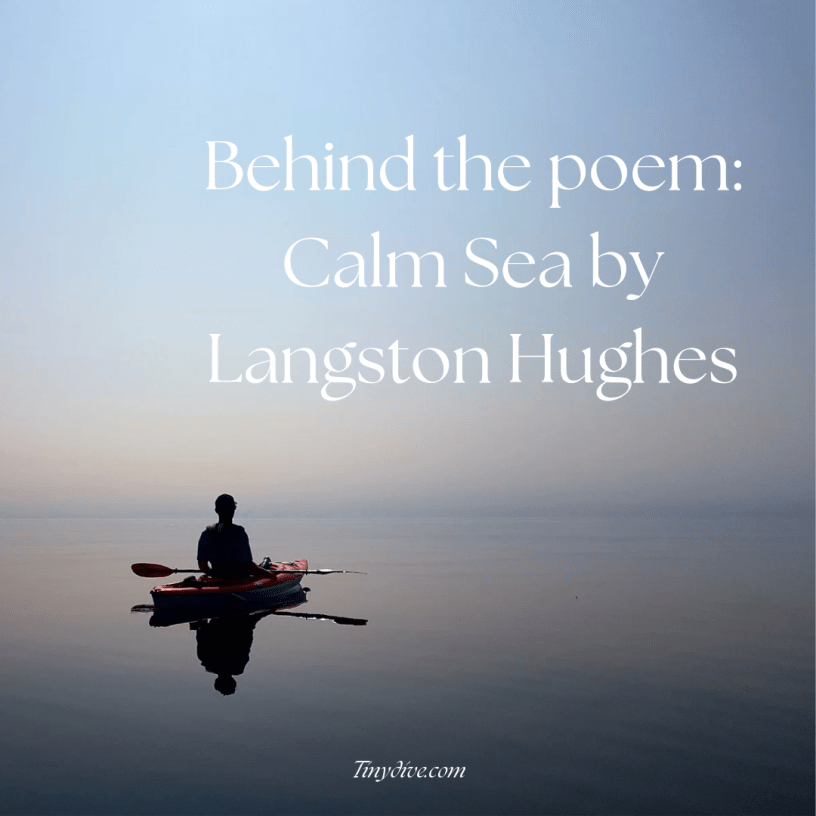
Sea Calm by Langston Hughes is a short but evocative poem that captures a moment of tranquility and reflection. With just a few lines, Hughes manages to evoke the vastness of the ocean, the stillness of the moment, and the profound emotions that such a scene can inspire. This essay will explore the poem’s themes, imagery, and structure, shedding light on how Hughes conveys a sense of peace and introspection.
The poem reads:How still, How strangely still The water is today, It is not good For water To be so still that way.
The first notable aspect of the poem is its brevity. Hughes uses only a few lines to convey his message, relying on simplicity and precision. This minimalistic approach mirrors the stillness of the sea that he describes. The repetition of the word “still” in the first two lines emphasizes the unusual calmness of the water. By stating, “How strangely still,” Hughes hints at an underlying tension or unease, suggesting that this calmness is out of the ordinary.
The imagery in the poem is vivid yet subtle. Hughes does not describe the sea in great detail, but the reader can easily visualize the scene. The stillness of the water is the central image, creating a sense of calm and serenity. However, this tranquility is tinged with a sense of foreboding. The phrase “It is not good / For water / To be so still that way” implies that this calmness is unnatural and possibly a precursor to something unsettling.
Hughes’s use of language is simple but effective. The poem’s structure, with its short lines and sparse punctuation, contributes to the feeling of stillness. There is a rhythmic quality to the poem that mirrors the gentle lapping of waves. The lack of complex metaphors or elaborate descriptions allows the reader to focus on the central image of the still sea and the emotions it evokes.
The poem can be interpreted in various ways. On one level, it is a straightforward description of a calm sea. However, it can also be seen as a metaphor for emotional or psychological states. The stillness of the water might represent a moment of introspection or a pause in the chaos of life. The unease suggested by the phrase “It is not good” hints at the idea that such moments of calm can be disconcerting, perhaps because they force us to confront our thoughts and emotions.
In the broader context of Hughes’s work, “Sea Calm” can be seen as part of his exploration of African American experiences and emotions. Hughes often wrote about the struggles and resilience of African Americans, and this poem’s sense of uneasy calm could be interpreted as a reflection on the calm before a storm, a moment of quiet before a period of upheaval or change.
In conclusion, Langston Hughes’s poem “Sea Calm” is a masterful example of how a few carefully chosen words can evoke powerful emotions and imagery. Through its simplicity and precision, the poem captures a moment of stillness and introspection, hinting at deeper undercurrents of tension and unease. Whether read as a literal description of a calm sea or a metaphor for emotional states, “Sea Calm” is a poignant and thought-provoking piece that showcases Hughes’s skill as a poet.
 Tiny Dive